
Editorial Guide
A practical resource for healthcare organizations evaluating technology, workflows, and operational requirements.
Different Strengths for Different Tasks
AI receptionists and human front-desk professionals are not interchangeable in every situation. Automation can assist with predictable administrative tasks, while people provide judgment, empathy, and flexibility.
The best operating model depends on patient needs, call complexity, staffing, and the reliability of the technology.
Where AI Can Help
AI tools may support routine office questions, after-hours administrative inquiries, basic routing, and appointment-related workflows.
Their effectiveness depends on accurate configuration, appropriate integrations, clear limitations, and reliable escalation.
Where Human Staff Remain Essential
Human receptionists can respond to emotional situations, unusual requests, sensitive discussions, and complex coordination challenges with context and judgment.
Clinical emergencies and medical decision-making should not be delegated to an administrative AI receptionist.
The Hybrid Front Desk
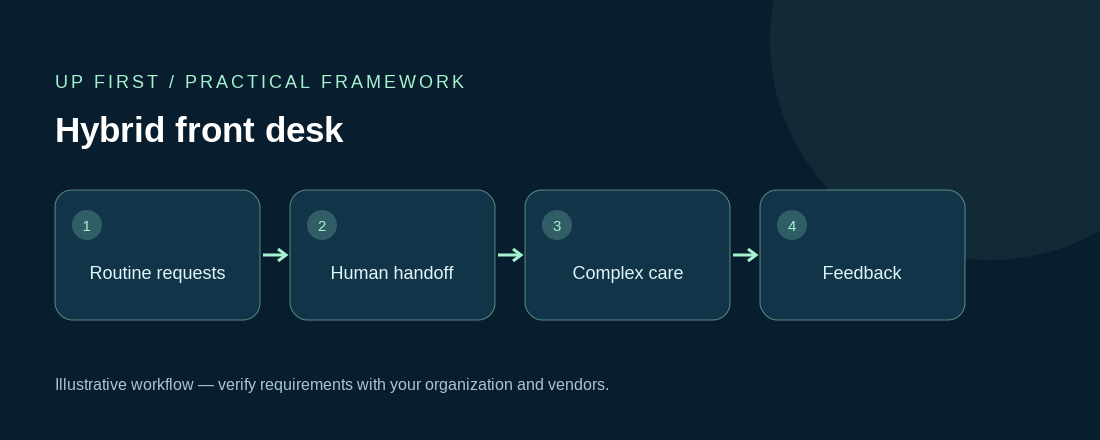
A hybrid model can use automation to handle suitable routine tasks while directing complicated or sensitive interactions to trained staff.
Organizations should define when escalation occurs, how context transfers, and who is accountable for unresolved requests.
How to Measure Success
Track call resolution, transfer accuracy, booking errors, patient complaints, and staff workload rather than evaluating success only by the number of automated conversations.
Patient experience and operational reliability should remain central to the decision.
Design Tasks Around Risk and Empathy
Routine information such as directions, opening hours, and basic appointment requests may be suitable for carefully configured automation. Calls involving grief, anxiety, complex insurance disputes, language barriers, or unusual clinical concerns often benefit from a trained person who can listen and exercise judgment. The dividing line should be based on risk and patient need rather than a blanket goal to automate every interaction.
For example, a patient calling to confirm parking instructions can receive a straightforward automated answer. A caller who says they are frightened by new symptoms should be routed through an approved clinical pathway. An administrative assistant should not attempt diagnosis or substitute for emergency guidance. This distinction should be built into scripts, training, and quality review.
What a Good Handoff Looks Like
A successful transfer preserves context without sharing more information than necessary. The staff member should understand the caller's purpose, what has already been attempted, and whether an action remains pending. Requiring the patient to repeat an entire conversation can undermine the benefit of automation.
Test transfers during busy hours, after hours, and when the destination is unavailable. Define whether the assistant takes a callback request, creates a task, or directs the caller to another channel. Staff must be able to identify unresolved requests and close the loop. A handoff is not complete merely because a call was forwarded.
Staff Experience Matters
Front-desk teams often manage interruptions, competing priorities, and emotionally demanding interactions. Removing repetitive inquiries may create more time for complex work, but automation can also introduce new review queues and error-correction tasks. Ask staff what changes in practice instead of assuming that automated minutes translate directly into staffing savings.
Include receptionists and scheduling coordinators in pilot design. Their knowledge of exceptions, provider preferences, and patient concerns is valuable when configuring workflows. A good implementation gives staff clear control over escalation, corrections, and temporary shutdown when the system behaves unexpectedly.
Choose a Hybrid Operating Model
Define which categories are automated, which require a person, and which always follow clinical protocols. Establish performance thresholds for each category, including booking errors, transfers, complaints, and follow-up completion. Review metrics by call type rather than treating all conversations as equivalent.
A hybrid model should remain flexible. Seasonal demand, staffing changes, new locations, or a scheduling-system migration may require adjustments. The objective is reliable access and a respectful patient experience, not automation for its own sake.
Further reading
Official resources for additional context; these links do not imply endorsement.
Continue your research
Compare healthcare AI platforms, review their focus areas, and confirm product capabilities directly with vendors before making a decision.
Explore Comparison Guide →