
Editorial Guide
A practical resource for healthcare organizations evaluating technology, workflows, and operational requirements.
Start With Your Clinic's Needs
An AI receptionist should solve specific operational problems rather than simply add another technology subscription. Review call volumes, peak hours, missed inquiries, appointment requests, and the tasks your front-desk team handles most often.
Different practices require different workflows. A small dental office may prioritize appointment requests, while a multi-location healthcare organization may need routing, language support, and more complex integrations.
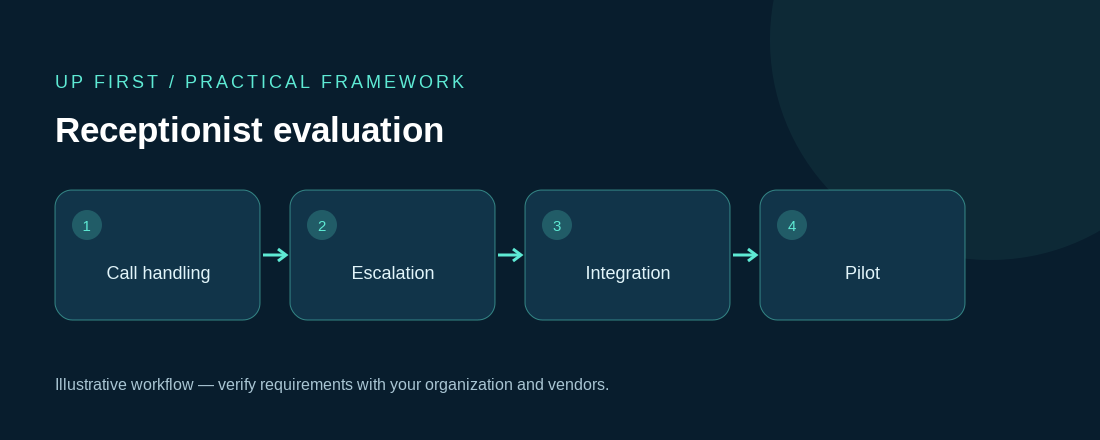
Evaluate Call Handling
Ask vendors to demonstrate real conversations, including interruptions, background noise, unclear requests, and callers who need a human representative.
Test whether the system can identify its limitations and transfer conversations appropriately instead of providing uncertain or potentially unsafe responses.
Check Scheduling Integrations
Confirm which scheduling systems are supported and whether integration is native, custom, or dependent on third-party middleware.
A demonstration should include appointment availability, booking confirmation, cancellations, and failure recovery.
Review Privacy and Security
Ask about encryption, access permissions, retention policies, audit logs, incident response, and business associate agreements where applicable.
A vendor's marketing claims should not replace your organization's security and compliance review.
Understand the Full Cost
Compare subscription fees, usage charges, implementation costs, phone-related charges, integration fees, and support arrangements.
Request a written explanation of what happens when usage exceeds the included allowance.
Run a Realistic Pilot
Test the product with common and difficult scenarios before signing a long-term contract. Measure successful routing, appointment accuracy, staff interventions, and patient feedback.
Choose the platform that performs reliably within your actual workflow, not simply the one with the most features.
Build a Scorecard Before Vendor Demos
Create a scorecard with categories such as call clarity, scheduling accuracy, language support, transfer behavior, reporting, accessibility, privacy, and support. Assign weights according to the practice's actual needs. A small practice with heavy after-hours demand may prioritize reliable message capture; a larger group may value multi-location routing and detailed permissions.
Use the same test script with every vendor. Include a routine office-hours question, an appointment change, a caller who interrupts repeatedly, an unclear name, a request for a human, and a question the assistant should not answer. Record what happened rather than relying on the quality of a polished sales demonstration.
Test Real Patient Journeys
A realistic journey begins before the phone rings. Ask how a caller reaches the system, how identity is handled, which data is collected, and whether a staff member receives enough context when the call transfers. If the assistant takes an appointment request, determine who confirms it and how the patient learns the outcome.
For multi-location clinics, test similar provider names, location-specific hours, and routing between departments. For multilingual patients, evaluate both comprehension and the accuracy of confirmations. Accessibility matters too: callers may speak slowly, use assistive devices, or need an alternative channel. A system that performs well only under ideal conditions is not ready for broad deployment.
Define Failure and Escalation Rules
Ask vendors what happens when a calendar connection times out, a caller expresses distress, or the assistant cannot understand a request. A safe system should have an approved fallback and should not pretend that an action succeeded. Staff need a clear queue for unresolved calls and a process for returning messages within an appropriate timeframe.
Document the boundaries of administrative automation. The receptionist should not diagnose, prescribe, or make independent clinical triage decisions. Urgent situations require the practice's established clinical protocols. Review recordings or transcripts only under the organization's privacy and retention policies, and make sure staff can correct inaccurate information.
Contract and Pilot Exit Checklist
Before signing, confirm data ownership, export options, termination provisions, support response expectations, implementation responsibilities, and any subcontractors that process information. Request an itemized estimate covering setup, phone usage, integrations, additional locations, and overages. Ask whether the pricing changes when call volume grows.
A pilot should have clear acceptance criteria: booking accuracy, transfer success, staff time saved, patient complaints, and unresolved request counts. Agree in advance on who can pause the system if errors appear. The best vendor is the one that meets documented requirements and provides evidence of reliable performance in your setting.
Further reading
Official resources for additional context; these links do not imply endorsement.
Continue your research
Compare healthcare AI platforms, review their focus areas, and confirm product capabilities directly with vendors before making a decision.
Explore Comparison Guide →