
Editorial Guide
A practical resource for healthcare organizations evaluating technology, workflows, and operational requirements.
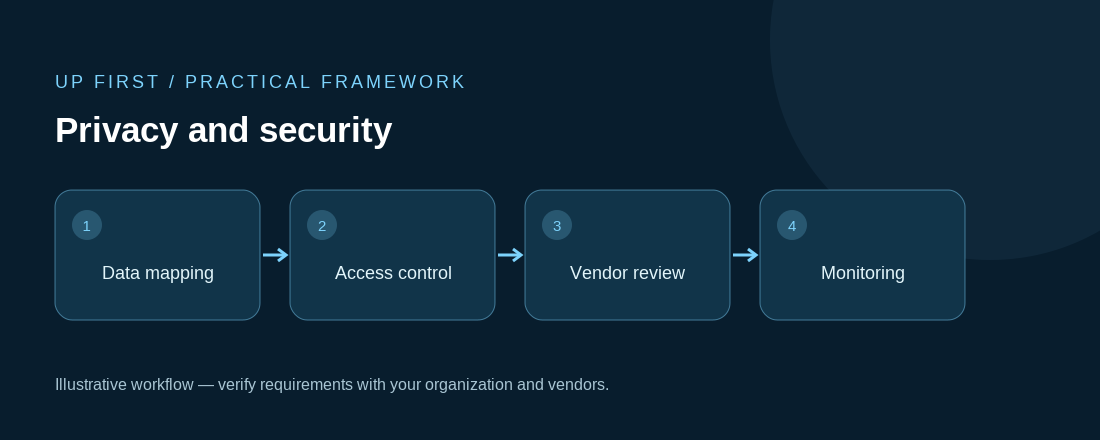
Why Healthcare AI Requires Careful Review
Healthcare AI platforms may process appointment details, patient messages, recordings, and other information that can qualify as protected health information under HIPAA.
Organizations should identify what data enters each system, where it is stored, who can access it, and whether it is shared with subprocessors.
Understand Vendor Responsibilities
When a vendor performs functions involving protected health information on behalf of a HIPAA-covered entity, a business associate agreement may be required.
Organizations should assess the vendor's actual role and data handling rather than relying solely on a website badge describing the product as HIPAA compliant.
Evaluate Security Safeguards
Relevant controls may include encryption, identity management, access restrictions, audit logging, incident procedures, and secure retention and deletion processes.
The appropriate safeguards depend on the data involved, the system architecture, and the organization's risk assessment.
Create Human Oversight Procedures
AI-generated administrative responses should be tested for accuracy and consistency. Clinical questions and urgent patient concerns require clearly defined escalation paths.
Staff should know how to review system performance, correct mistakes, and respond to privacy or security incidents.
Practical Evaluation Checklist
Before deployment, document data flows, review contractual responsibilities, assess vendor security materials, establish retention rules, and conduct realistic workflow testing.
This article provides general educational information, not legal advice. Healthcare organizations should consult qualified compliance and legal professionals regarding their specific obligations.
Map Protected Information Before Deployment
Start by listing each point where information enters the workflow: incoming calls, voicemail, transcripts, appointment requests, integrations, analytics, and support tickets. Determine whether a data element is protected health information in the relevant context and who is authorized to access it. A generic statement that a product is secure is not a substitute for understanding its actual data flows.
For each system, document storage location, retention period, deletion method, access roles, and third parties involved. Consider whether recordings are necessary for the workflow or whether a less detailed record would meet the operational need. Collecting less sensitive information can reduce exposure, but retention and access choices must be consistent with applicable requirements and clinical obligations.
Business Associate Agreements and Subprocessors
HIPAA-covered entities should evaluate whether a vendor is acting as a business associate and whether a written business associate agreement is required. The analysis depends on the vendor's functions and relationship to protected health information, not on whether the vendor uses the term artificial intelligence. Review relevant HHS guidance and involve the organization's privacy or legal team.
Ask the vendor to identify subprocessors and explain how they handle patient information. Review permitted uses, safeguards, incident notification obligations, return or destruction of information, and termination terms. A signed agreement is important where required, but it does not replace a security risk assessment or ongoing operational controls.
Security Controls Worth Testing
Request evidence about identity and access management, least-privilege roles, encryption, audit logging, secure development, incident response, and backup recovery. Test whether a former employee's access can be revoked promptly and whether administrative actions are logged. Ask who can retrieve transcripts and how requests are authenticated.
Do not assume that a single certification, marketing badge, or encryption claim establishes compliance. Risk analysis should reflect the practice's specific environment, integrations, staff responsibilities, and reasonably anticipated threats. Healthcare organizations should consult official HHS HIPAA resources for their obligations and use qualified advisers when decisions are legally consequential.
Operational Governance and Patient Communication
Create a documented process for approving the assistant's answers, reviewing incidents, handling patient complaints, and escalating clinical questions. Staff should know how to intervene when a caller needs a person or when the system produces inaccurate information. Governance is an ongoing responsibility, not a one-time installation task.
Review whether notices, consent processes, recording practices, and state-specific rules apply to the proposed workflow. These requirements can differ by location and use case. This guide is educational and does not determine whether any particular AI product or clinic is HIPAA compliant; a context-specific legal and security review remains essential.
Further reading
Official resources for additional context; these links do not imply endorsement.
Continue your research
Compare healthcare AI platforms, review their focus areas, and confirm product capabilities directly with vendors before making a decision.
Explore Comparison Guide →