
Editorial Guide
A practical resource for healthcare organizations evaluating technology, workflows, and operational requirements.
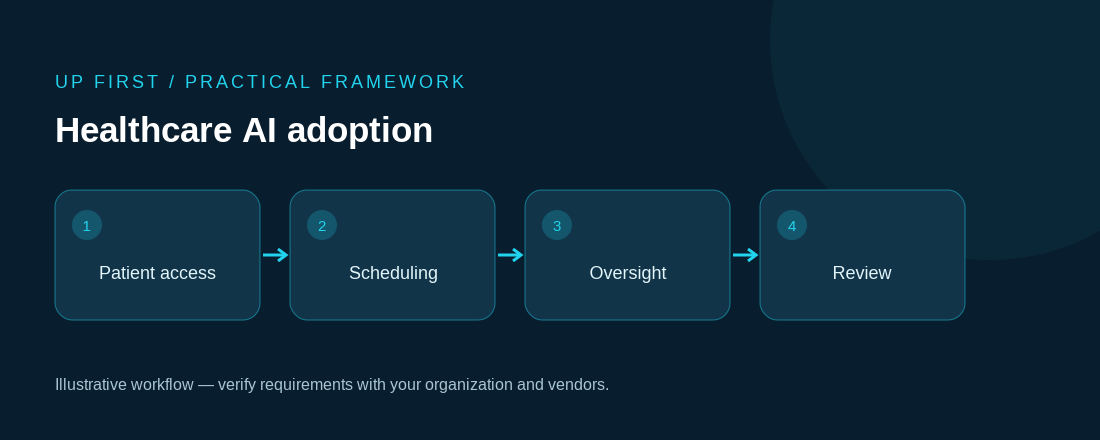
Healthcare AI Is Moving Into Everyday Operations
Healthcare artificial intelligence is increasingly relevant to the administrative work that surrounds patient care. Medical practices are evaluating tools for answering routine inquiries, coordinating appointments, organizing intake information, and supporting communication across multiple channels.
The practical question is no longer simply whether a platform uses AI. Practices need to understand which workflows it can reliably support, where human intervention remains necessary, and how the technology fits existing systems.
Patient Access and Communication
AI-assisted reception and communication tools can help practices respond to routine questions when staff are unavailable. Potential applications include office information, appointment requests, and directing patients to appropriate administrative resources.
These systems should have clear escalation procedures. Urgent symptoms, complex clinical questions, and sensitive conversations require appropriate human or clinical involvement.
Scheduling and Workflow Automation
Scheduling automation can reduce repetitive administrative steps when a platform integrates correctly with practice calendars and scheduling rules.
Before adopting a system, organizations should test appointment conflicts, cancellations, provider availability, time zones, and what happens when an integration fails.
Privacy and Responsible Implementation
Healthcare organizations must evaluate privacy, security, access controls, data retention, vendor agreements, and applicable regulatory requirements before introducing AI into patient-facing workflows.
A successful rollout should include staff training, documented escalation policies, testing with realistic scenarios, and ongoing performance reviews.
What Practices Should Do Next
Start with a clearly defined operational problem. Identify the current workload, establish measurable goals, compare suitable vendors, and run a controlled pilot before expanding.
The strongest implementation strategy combines useful automation with accountable human oversight.
The Rise of Hybrid Patient Access
A practical 2026 trend is the combination of digital self-service with human-led care coordination. A patient may begin with a phone call, request an appointment, receive a confirmation, and later need a person to resolve an insurance or accessibility question. The handoff matters as much as the automated response. Practices should map this journey before buying software, identify where information can be lost, and assign an owner to every unresolved request.
For example, an orthopedic practice could let an assistant collect a preferred appointment window without promising a confirmed booking until the scheduling system validates the slot. A patient who mentions a new injury should be directed to the practice's approved clinical triage process rather than treated as a routine administrative inquiry. This distinction protects both patient experience and operational reliability.
Data Quality Is an Operational Requirement
Automation is only as useful as the information it can access. Outdated office hours, inconsistent provider names, conflicting scheduling rules, or incomplete location information can create inaccurate answers at scale. Before launch, designate a content owner who reviews FAQs, provider calendars, phone-routing rules, and approved patient instructions. Make changes traceable and test them after each update.
A good rollout includes a fallback when connected systems are unavailable. The assistant should acknowledge uncertainty, collect only necessary information, and route the request for follow-up. Avoid inventing available appointments or presenting an unverified response as a confirmed transaction. Practices should test these edge cases during a pilot, not after patients encounter them.
Measuring Adoption Beyond Call Volume
A high number of handled calls does not automatically mean a better patient experience. Track how often requests are correctly resolved, transferred to staff, abandoned, or require later correction. Separate routine questions from scheduling changes and clinically sensitive inquiries so that performance metrics reflect different levels of complexity.
Compare results with a baseline from before implementation. Review a representative sample of conversations where permitted, examine staff feedback, and ask patients whether they reached the right destination. Improvements should be assessed alongside privacy, accessibility, language support, and patient safety rather than reduced to a single automation percentage.
A Responsible 90-Day Evaluation
During the first month, document workflows, assess privacy obligations, and test vendor demonstrations with realistic calls. During the second month, pilot a narrow set of administrative tasks with clear human escalation. In the third month, review errors, operational metrics, staff workload, and patient feedback before expanding scope.
The sequence is a planning example rather than a universal timetable. Organizations with complex integrations or higher-risk data flows may need longer. The goal is to make adoption reversible, measurable, and accountable. A well-governed pilot is more useful than a broad launch without a reliable way to detect mistakes.
Further reading
Official resources for additional context; these links do not imply endorsement.
Continue your research
Compare healthcare AI platforms, review their focus areas, and confirm product capabilities directly with vendors before making a decision.
Explore Comparison Guide →