
Editorial Guide
A practical resource for healthcare organizations evaluating technology, workflows, and operational requirements.
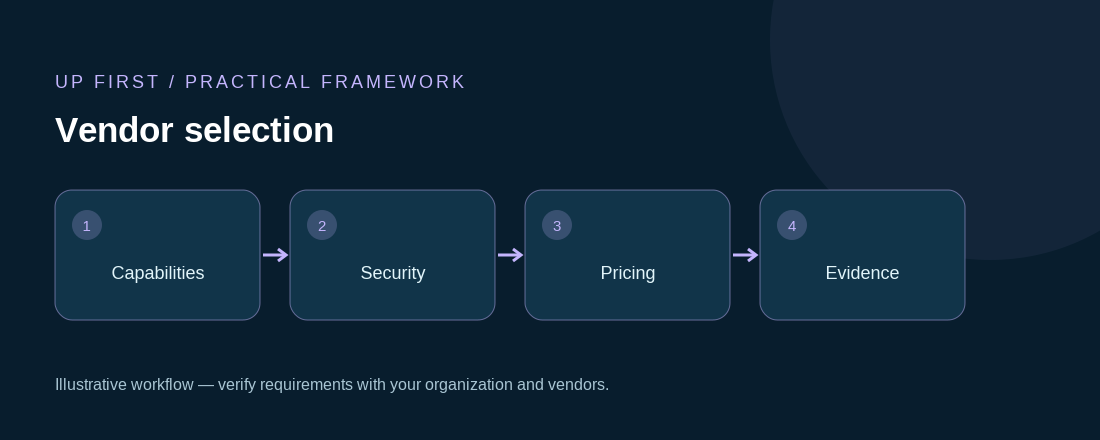
Questions 1–3: Capabilities and Reliability
1. Which specific healthcare workflows does the platform support today, and which features are still planned?
2. Can the vendor demonstrate difficult real-world scenarios, including unclear requests and interruptions?
3. How does the system escalate urgent, sensitive, or unresolved interactions to trained staff?
Questions 4–5: Integration and Implementation
4. Which practice management, scheduling, and communication systems integrate with the product?
5. What implementation work, staff training, and technical support are required before launch?
Questions 6–7: Privacy and Security
6. What patient information is collected, processed, stored, retained, and shared with subprocessors?
7. What contractual, security, and compliance documentation can the vendor provide, including a business associate agreement where applicable?
Questions 8–9: Pricing and Support
8. What is the complete pricing model, including usage limits, setup fees, integration costs, and overage charges?
9. What support is available when the system fails, and what service commitments are documented?
Question 10: Evidence of Results
10. What measurable outcomes can the vendor demonstrate, and how can your organization independently evaluate them during a pilot?
A structured evaluation helps practices make decisions based on fit, operational reliability, and verified information rather than promotional claims.
Turn Answers Into Verifiable Evidence
A useful vendor evaluation asks not only what a platform can do, but how the claim can be tested. Request a live demonstration using your own scenarios, a written list of supported integrations, and documentation of limitations. Separate features that are available today from roadmap promises and custom work that would require additional fees.
Keep a shared decision log with the vendor's answer, supporting evidence, open questions, and the person responsible for follow-up. This makes it easier for clinical operations, IT, compliance, and finance to review the same information without relying on memory from a sales call.
Use a Consistent Scoring Rubric
Score each vendor against the same criteria: workflow fit, accuracy, escalation, privacy, integration, usability, support, and total cost. Assign importance weights before viewing demonstrations. If patient safety or a required integration is a non-negotiable condition, treat it as a gate rather than something that can be offset by a lower price.
Record uncertainty instead of assigning full marks to an unverified promise. A vendor that cannot demonstrate an important feature should receive a pending status until evidence is supplied. This approach helps teams compare products fairly and reduces the influence of presentation quality alone.
Pilot Scenarios That Reveal Weaknesses
Include a routine scheduling request, a cancellation, an ambiguous provider name, a request in another supported language, an interrupted caller, an unavailable integration, and a caller who needs a person. Test after-hours behavior and whether messages are assigned to the correct team. Confirm that the system does not invent a booking confirmation.
Where appropriate, include sensitive scenarios that must trigger an approved escalation process rather than an automated clinical answer. Document expected behavior before testing and compare it with the actual outcome. A repeatable test script gives the practice a more useful picture than an isolated success story.
Make the Final Decision Transparent
Before approval, summarize the strongest evidence, unresolved risks, implementation dependencies, contract terms, and pilot results. Identify who will maintain knowledge content, review errors, manage permissions, and communicate changes to staff. The operational owner should be clear before the first patient-facing call.
If no vendor meets essential requirements, postponing a purchase may be better than accepting a fragile workflow. A thoughtful decision should remain defensible after the sales presentation is over. Use official regulatory and security guidance as part of due diligence, and consult specialists when a requirement is outside the team's expertise.
Further reading
Official resources for additional context; these links do not imply endorsement.
Continue your research
Compare healthcare AI platforms, review their focus areas, and confirm product capabilities directly with vendors before making a decision.
Explore Comparison Guide →